: Included in Psychoanalysis<>Politics: Special Issue by the Group for Independent Formation, this essay weaves together autotheory, field notes, and psychoanalytic research to explore subjectivity, those erased by institutions, and the politics of listening through both psychoanalytic reflection and visual practice.
-
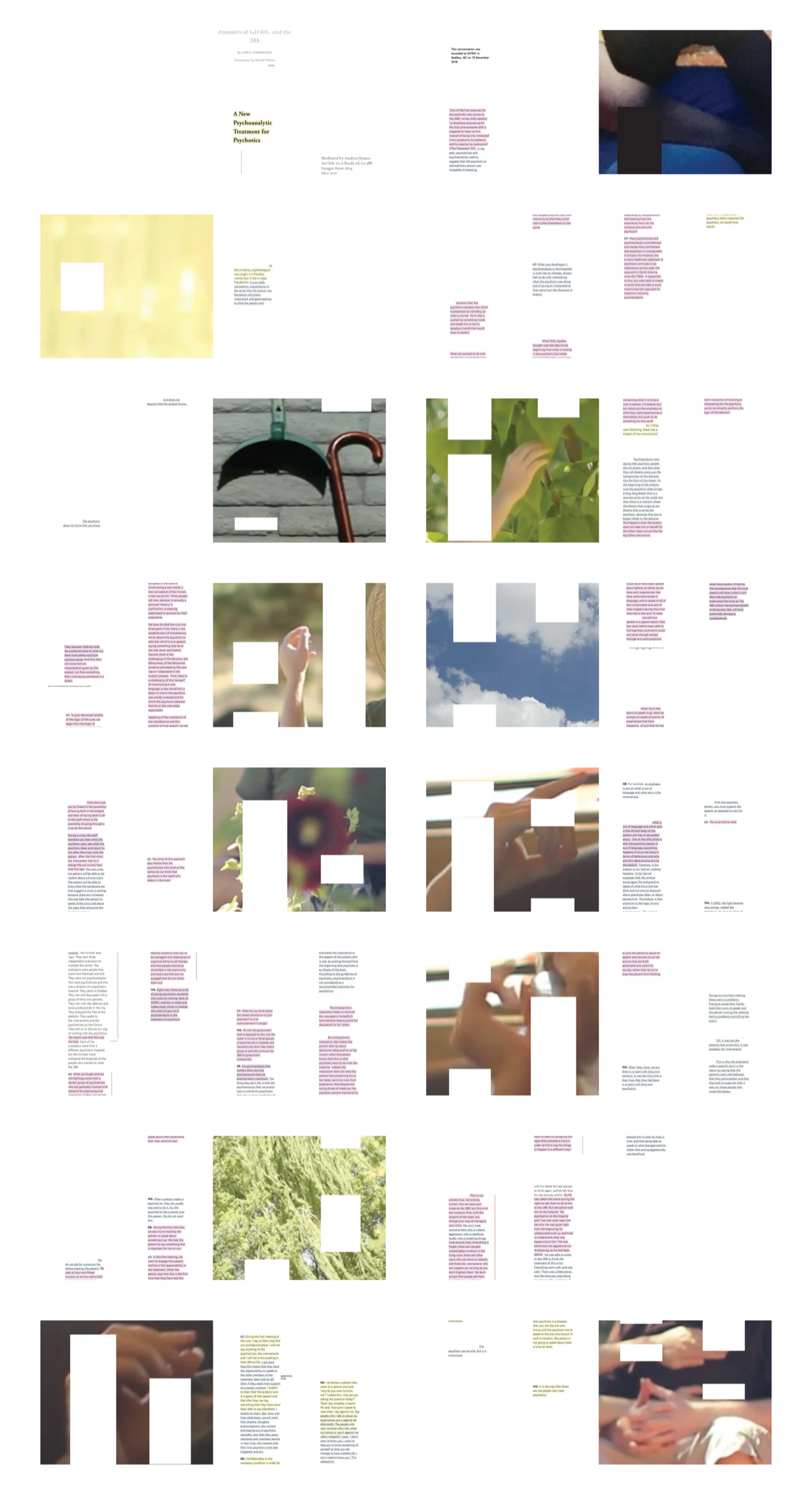
Included in Psychoanalysis<>Politics: Special Issue by the Group for Independent Formation and written in response to their conference Psychoanalysis and Politics: The Impossible Relation, this hybrid essay weaves together autotheory, field notes, and psychoanalytic research to trace how an encounter with Le 388 (a psychoanalytic clinic for psychosis in Québec founded by GIFRIC members and designed in the lineage of Institutional Psychotherapy) became the catalyst for an ongoing artistic and clinical inquiry, leading to the artist book Ode to Le 388. Moving between a Brooklyn conference and visits to the psychiatric institution, the piece and the larger research explores subjectivity, those erased by institutions, and the politics of listening through both psychoanalytic reflection and visual practice.
“Psychosis resists conventional language; it speaks in symbols. My brother and I often communicate through non-verbal forms: gesture, pattern, silence. This visual project attempts to meet the language of psychosis itself. The closure of Le 388 reminds us that our systems continue to marginalize those who live at the edges of comprehension. By working directly with the clinic founders’ words, I hope to re-present their interview as both testimony and resistance—to offer a counter-paradigm to the dehumanizing frameworks that often shape psychiatric treatment. This, to me, is political.”
Special thanks to Daniel Gardner, Ph.D., who advised my capstone research; Christopher Chamberlin for his generous consultation and conversations throughout the development of this work; Jason Royal for his editing; and Lily Meyersohn for additional editing. -
The Psychoanalysis<>Politics: Special Issue begins from the premise that the relation between psychoanalysis and politics is an "impossible relation"—not because the two are unrelated, but because they continually unsettle one another. Rather than seeking a unified theory, the collection explores the tensions, contradictions, and productive encounters that emerge when psychoanalytic thinking is brought into dialogue with political life. Across philosophy, clinical practice, history, and artistic inquiry, the essays consider questions of subjectivity, institutions, violence, language, democracy, and social transformation, asking what psychoanalysis can contribute to understanding political life while remaining attentive to the singularity of subjective experience.
The issue includes contributions from David Pavón-Cuéllar, Gabriel Tupinambá, Silvia Lippi, Melissa A. Wright, Fernando Castrillón, and members of the Group for Independent Formation, among others.
The EJP is a broad-based, fiercely independent, peer-reviewed, multilingual journal dedicated to a consistently high-level engagement between Europe, the Americas, South Asia, the Middle-East and North Africa on enduring and topical questions in psychoanalysis, philosophy, the arts and contemporary social thought more broadly. We have published works by the leading lights in the field for 25 years. EJP is not an organ of any one school or orientation, preferring instead to provoke exchange between often alienated sub-fields and areas of inquiry.